
October 20, 2026 · Dennis Miguel
How to Get Your Business Recommended by AI: ChatGPT, Gemini, Perplexity and More
45% of consumers now ask AI to recommend local businesses. Here's how ChatGPT, Gemini, Perplexity, Claude and Copilot choose, and how to get named by all of them.
Ask ChatGPT, Gemini or Perplexity for “the best dentist in Encinitas” and you get a short list of names. Not ten blue links. A few businesses, a line about each, and a recommendation. If your business isn’t on that list, the customer never sees you. This guide shows how to get your business recommended by AI assistants, including ChatGPT, Google Gemini and AI Mode, Perplexity, Claude and Microsoft Copilot, based on studies published in 2026.
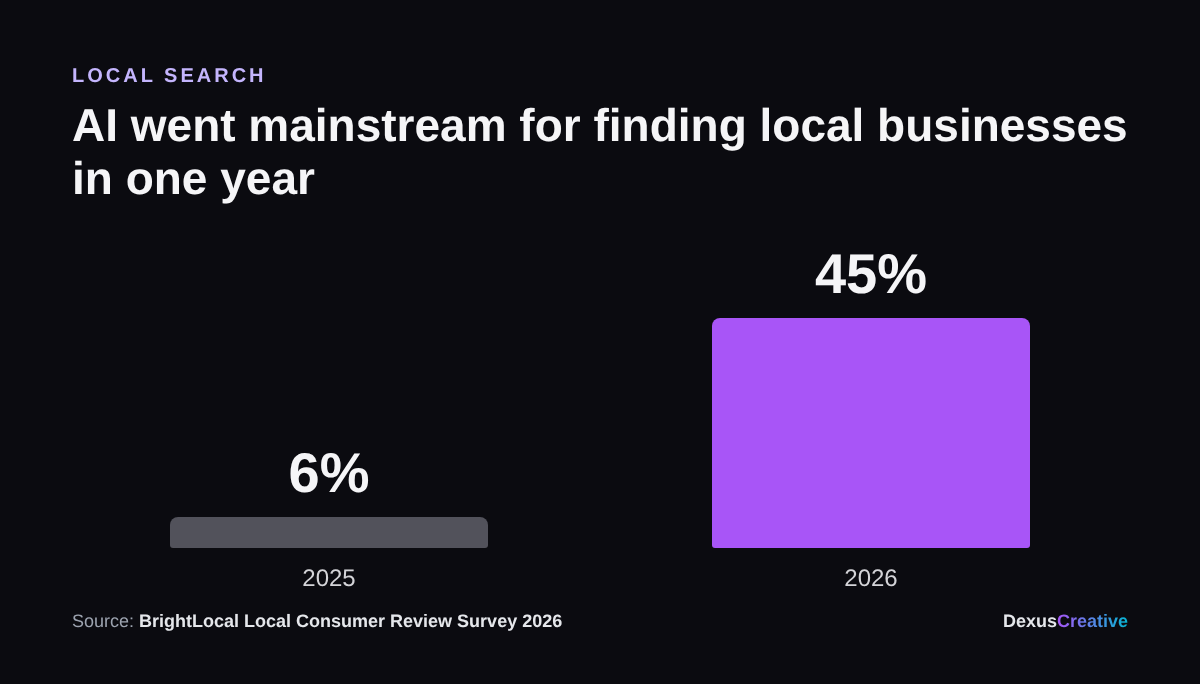
This isn’t a future problem. In BrightLocal’s 2026 Local Consumer Review Survey, 45% of consumers said they used an AI tool to find a local business in the past year, up from 6% the year before. AI is now the third most used source for local recommendations, behind only Google and Facebook, and ahead of Yelp and TripAdvisor.
So the question every owner should be asking is simple: does AI recommend my business? Here’s what the newest research says about how these tools choose, and what you can do about it.
Key takeaways
- 45% of consumers now use AI tools to find local businesses (BrightLocal, 2026).
- AI assistants favor businesses located in the city you asked about, with a 4.8★+ rating and more reviews than nearby competitors.
- Each assistant reads different sources: ChatGPT leans on directories and review sites, Gemini and AI Mode on Google’s own listings, Copilot on Bing.
- AI answers change from one ask to the next, so aim to be named often, not to “rank #1.”
- The assistants rarely agree with each other, so you need to be visible on all of them, not just one.
- You can’t pay to be recommended. ChatGPT ads are labeled and separate from the answer.
The short answer: probably not as often as you think
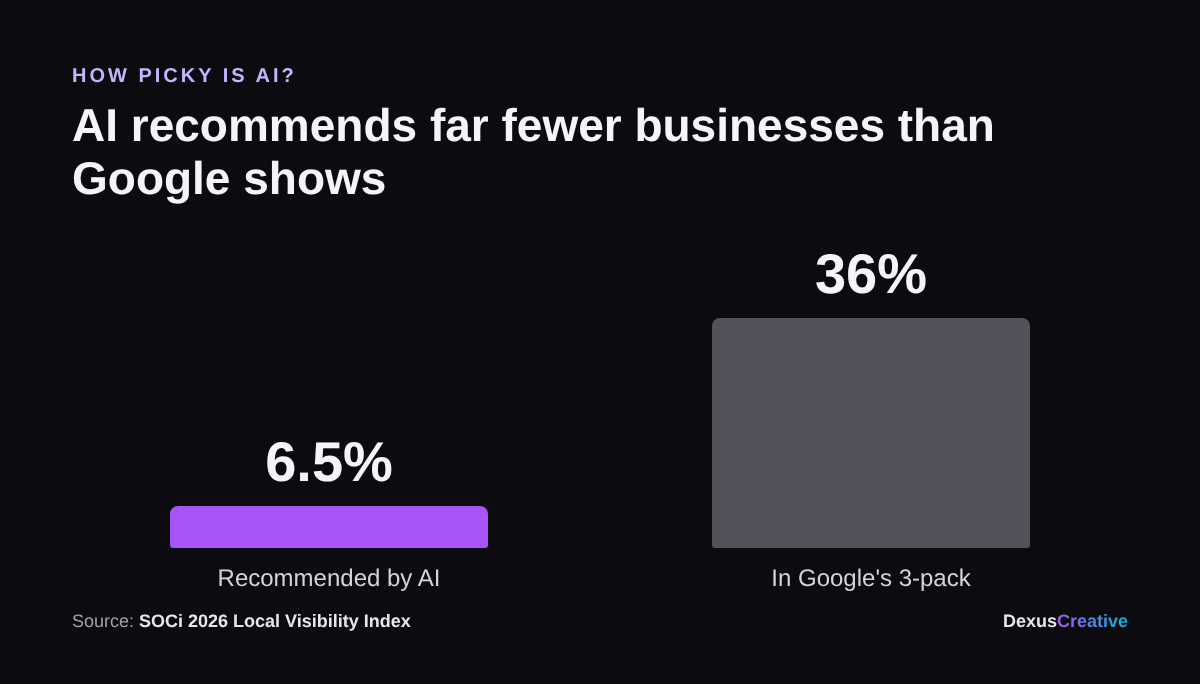
AI tools are far pickier than Google. SOCi’s 2026 Local Visibility Index, which looked at more than 350,000 locations across 2,751 brands, found multi-location brand locations showed up in AI recommendations just 6.5% of the time. The same locations appeared in Google’s local 3-pack about 36% of the time.
There’s good news buried in that study for small businesses: SOCi found AI tools tend to favor single-location businesses, because their reviews, listings and local signals are simpler and more consistent. A focused local business can beat a national chain here.
Can you “rank” on ChatGPT or Gemini? Not the way you think
On Google, you can track where you rank. AI answers don’t work that way. Ask the same question twice and you can get different names.
- A study of 216 U.S. markets by Spearleaf (August 2026) asked ChatGPT the same local question twice, 4 to 9 days apart. Only 48% of the businesses shown the first time showed up again. The top pick stayed the same in just 34% of markets.
- Google’s regular map results barely moved over the same window.
- A field test of 250 AI recommendations by Ryan Doser (October 2026) found ChatGPT, Claude, Gemini and Perplexity never all agreed on the first business across 12 local questions.
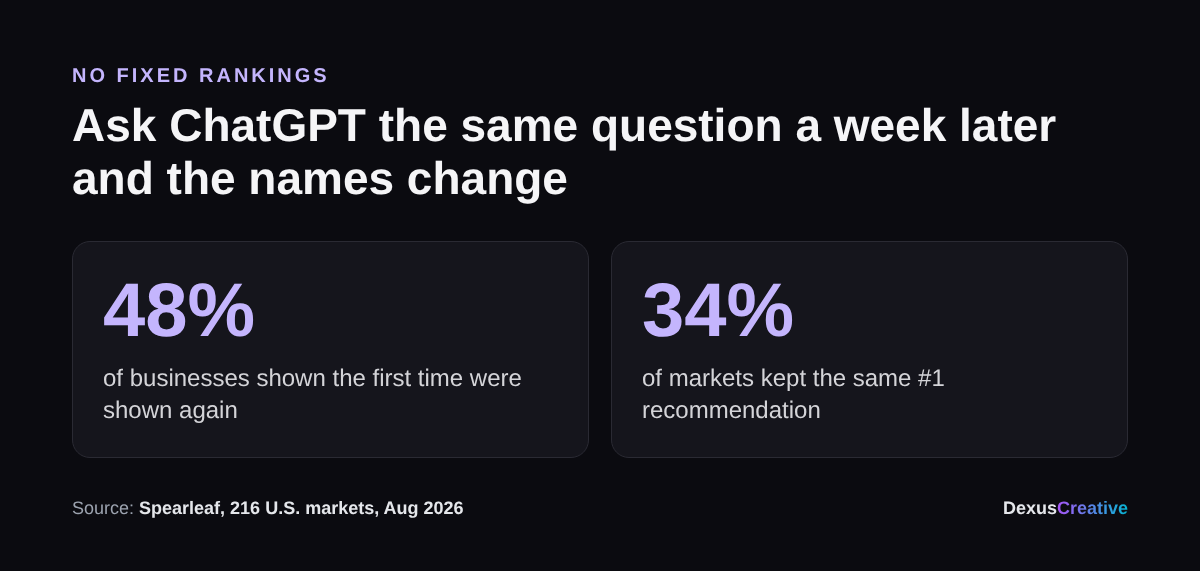
That means the goal isn’t to “rank #1 in ChatGPT.” It’s to be the business AI keeps picking back up, on every assistant, every time it looks.
Can you pay AI to recommend your business?
No. OpenAI started showing ads in ChatGPT in 2026, but they appear as labeled cards below the answer, and OpenAI says ads don’t influence what ChatGPT recommends. Getting named in the answer itself still comes down to the signals below.
Where each AI assistant gets its information
Every assistant searches the web before it answers, but they don’t all read the same places. That’s why they so often disagree.
- ChatGPT is the most used: 31% of consumers have used it for a local recommendation (BrightLocal). For local searches it mostly cites directories and review sites like Birdeye, Expertise.com, Angi and Yelp.
- Google Gemini and AI Mode are next, with 23% of consumers using AI Mode. They draw on Google’s own data, so your Google Business Profile and Google reviews matter most here. In Spearleaf’s data, 88% of businesses named in Google’s AI Overview were already in the regular map results.
- Perplexity shows its sources on every answer, which makes it the easiest place to see which sites you need to be on.
- Claude tended to name more, smaller local operators in Doser’s test, including real businesses with no Google Maps listing it could find.
- Microsoft Copilot is built on Bing search, so a claimed and complete Bing Places listing helps.
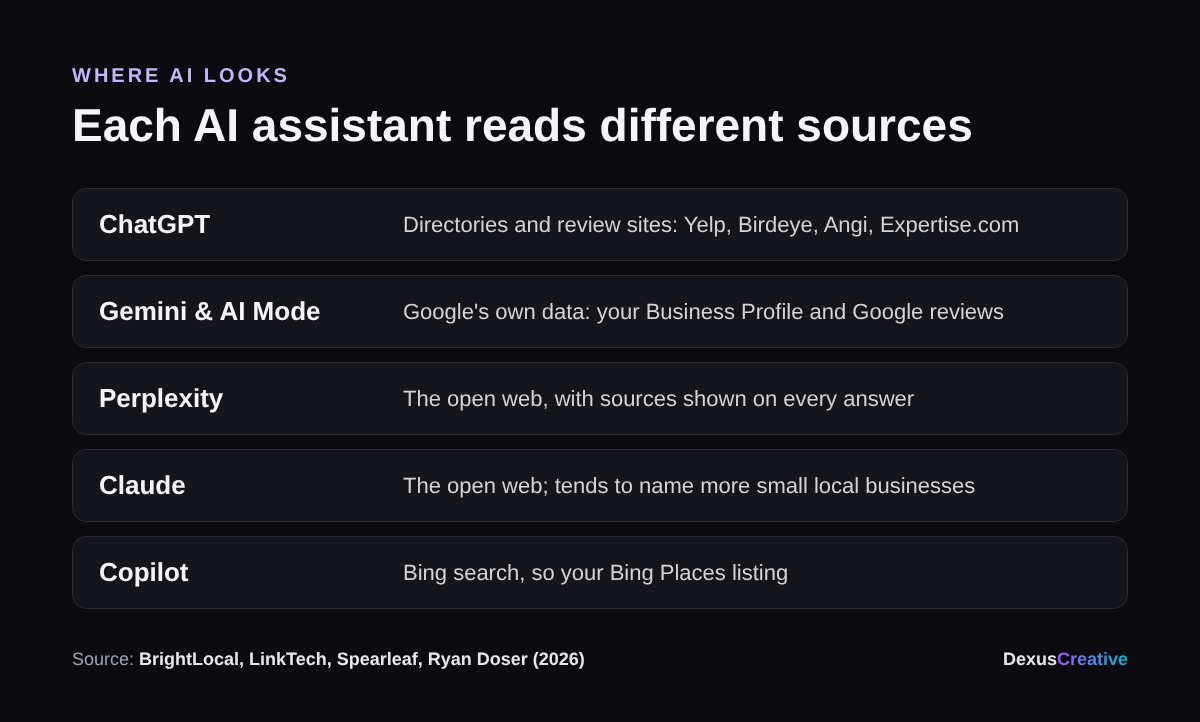
The takeaway: a business that only exists on Google is easy for the other assistants to miss. Claim your listings on Google, Bing and Apple Maps, and keep your reviews spread across the sites your customers use.
How AI decides which businesses to recommend
Across the studies, the same few signals keep separating businesses that get named from those that don’t.
1. You’re clearly in the city they asked about
In Spearleaf’s data, 92% of businesses ChatGPT displayed had an address in the city in the question, against 74% of the businesses it passed over. A 20-search study of Orange County and the Inland Empire by LinkTech (September 2026) found the same thing: 81% of listed businesses were in the city asked about, and big, well-reviewed companies from the next town over sat at the bottom of the list.
If you serve Carlsbad, Oceanside and Escondido, say so plainly on your Google profile and your website. Don’t make AI guess.
2. A deep bench of reviews at a near-perfect rating
Ratings are the price of entry. Across Spearleaf’s markets, the lowest rating on a typical ChatGPT list was 4.8 stars. Review volume is what separates you after that: businesses ChatGPT kept showing a week later had a median of 226 reviews, against 164 for the ones it dropped.
How many you need depends on your trade. In LinkTech’s study, the median plumber on ChatGPT’s list had about 220 reviews. The median personal injury lawyer had 13. Compare yourself to the businesses in your own trade and city, not a national number.
3. Your reviews live in more places than Google
ChatGPT can’t see everything inside Google. BrightLocal’s CEO put it bluntly: if your reputation only exists on Google, you’re close to invisible to people using ChatGPT. In Spearleaf’s study, 17% of the ratings ChatGPT showed came from Yelp, not Google. Reviews on Yelp, Facebook and the directories in your industry all count.
4. You’re listed on the directories AI actually reads
This is the one most owners miss. In LinkTech’s study, 45 of the 53 sources ChatGPT cited were directories or review lists, like Birdeye, Expertise.com and Angi. Only two were business websites. For lawyers, it was State Bar pages. Spearleaf found the same pattern, with Birdeye’s review pages as the site ChatGPT pulled most often.
If you’re missing from the directories in your trade, AI has nothing to quote about you.
5. Your details match everywhere
AI pulls your name, address, phone and hours from many sources and doesn’t reconcile them. SOCi calls every mismatch a sign of “uncertainty.” In Doser’s test, AI gave a phone number that didn’t match the company’s Google listing in 7 of 250 recommendations, and one answer sent people to a website that now redirected to a domain-for-sale page.
Old listings, a second phone number, last year’s hours: each one gives AI a reason to pick someone else, or to get your details wrong when it does name you.
6. Signs you’re active right now
AI favors businesses that look open and busy today. SOCi lists freshness first in its framework: recent reviews, replies to reviews, updated posts and photos. A profile that hasn’t changed in a year reads as a risk.
Strong on Google doesn’t mean strong in AI search
It’s tempting to assume a good map ranking carries over. It only partly does. In Doser’s test, just 23% of AI picks were in Google’s top 3 for the same search. ChatGPT matched Google most often, and still only 31% of its picks came from the top 3.
The foundations are the same, though. Reviews, accurate listings, clear location and an active profile help you on Google and in AI. You don’t need a separate playbook. You need the basics done everywhere, not just on Google.
How to check if AI recommends you (5 minutes)
- Open ChatGPT, Gemini (or Google AI Mode), Perplexity, Claude and Copilot. Make sure web search is on where it’s optional.
- Ask the question your customers ask, with your city in it: “Can you recommend a [your service] in [your city]?”
- Write down every business it names, in order, and the sources it cites.
- Ask again in a new chat. Then do it again next week. You’re looking for how often you show up, not one result.
- Check what it says about you. Is the phone number right? The hours? The website?
If competitors keep showing up and you don’t, look at what they have that you don’t: more reviews, a listing on a directory you’re missing, or an address in the city you’re trying to win.
How to get your business recommended by ChatGPT, Gemini and other AI assistants
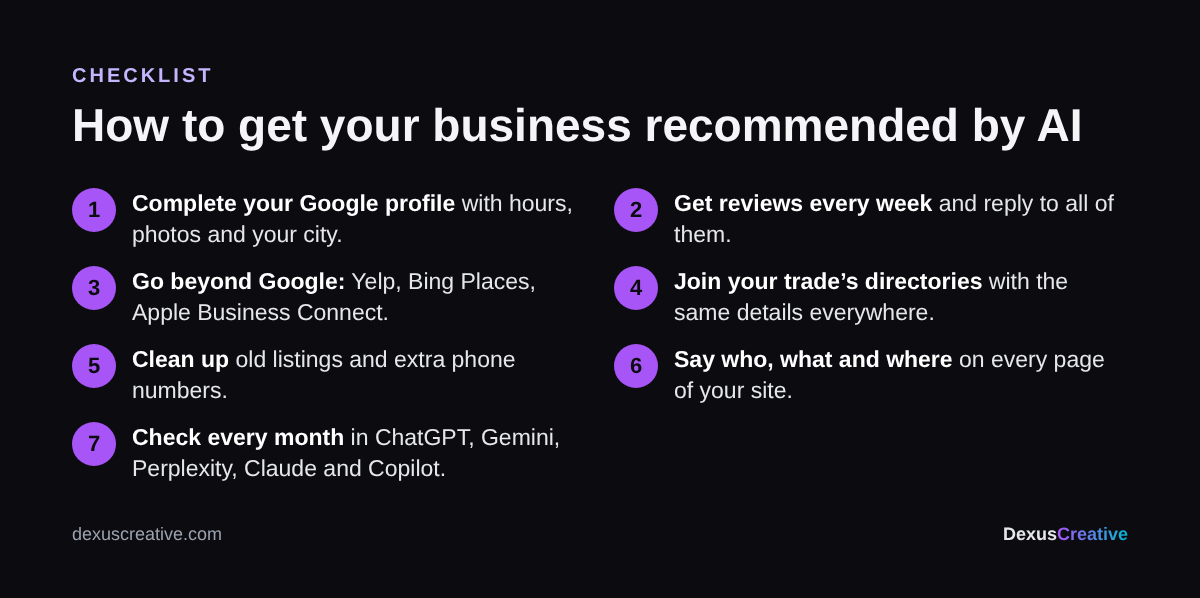
- Google Business Profile: correct category, hours, phone, website, photos and a description that names your city and services.
- Reviews: ask every happy customer, every week. Reply to every review, good or bad.
- Beyond Google: claim Bing Places and Apple Business Connect, and build reviews on Yelp, Facebook and the review sites your industry uses.
- Directories: get listed on the ones your trade gets cited from, with the same name, address, phone and category everywhere.
- Clean up: close duplicate or old listings and use one main phone number.
- Website: say plainly who you are, what you do and where, with your address and phone on every page and local business schema in the code.
- Check monthly: run the 5-minute test above and track who gets named.
See where you stand
We built two free tools for local businesses to check this without guesswork. The Free LLM Visibility Audit checks whether your website gives AI what it needs to understand and cite you. The Free Local SEO Audit checks your Google profile, reviews and map rank against the businesses AI is most likely to name in your area.
No calls, no signup to see your score.
About Dexus Creative
Dexus Creative is a San Diego marketing agency for local businesses with high-value customers, like dental practices, med spas, roofers and other home services. We’re a small team that does the whole job in-house, so you deal with one partner instead of a videographer, an ads freelancer and an SEO vendor who never talk to each other.
- Short-form video, shot and edited by us. We film at your business, so every ad and post shows your real team and your real work.
- Paid ads on Meta, Google and TikTok. We use that video as ad creative and test it fast.
- Local SEO and AI visibility. Google Business Profile, reviews, service pages, and the listings ChatGPT and Gemini read when they recommend businesses.
- Landing pages and tracking built for each campaign, so every lead is counted.
How we work: we test with a small budget, measure cost per lead and per new customer, and only scale what pays for itself. You get a clear report every month. We also offer a retainer-plus-equity model for growth-stage businesses, so we win when you do.
Results we’ve published: 40% year-over-year growth for Excelarace, a first product run that sold out in under two months for BoBlocks, and 900+ pre-launch users for CareTabs.
Questions about your AI visibility? Get in touch with Dexus Creative.
Sources
- BrightLocal, Local Consumer Review Survey 2026: AI recommendations and trust (1,002 U.S. adults)
- SOCi, 2026 Local Visibility Index: AI visibility for brands (March 2026)
- Spearleaf, study of ChatGPT local recommendations across 216 U.S. markets (August 2026)
- LinkTech Solutions, How ChatGPT Picks Local Businesses: A 20-Search Study (September 2026)
- OpenAI, Building advertising for the way people use AI (October 2026)
- Ryan Doser, Does ChatGPT Recommend Local Businesses? 250 AI Picks Tested (October 2026)
Frequently Asked Questions
ChatGPT, Gemini, Perplexity, Claude and Copilot search the web when you ask, then name a short list of nearby businesses. Recent studies show the businesses they name are usually located in the city you asked about, have a near-perfect rating with a deep bench of reviews, and appear on the sources each assistant reads: directories and review sites for ChatGPT, Google's own listings for Gemini and AI Mode, and Bing for Copilot.
No. ChatGPT began showing ads in 2026, but they are labeled cards shown below the answer, and OpenAI says ads do not influence what ChatGPT recommends. Being named in the answer depends on your location, reviews, listings and consistent business details.
Not automatically. In a 2026 field test of 250 AI recommendations, only 23% were businesses in Google's top 3 map results for the same search. The same basics help on both: reviews, accurate listings, a clear location and an active profile.
Start with the basics AI tools read: a complete Google Business Profile, steady reviews on Google and other review sites, listings on the directories your industry uses, the same name, address and phone everywhere, and a website that says plainly who you are, what you do and where. Then check every month by asking ChatGPT, Gemini and Perplexity the questions your customers ask.
It depends on your trade and city. One 2026 study found the median plumber on ChatGPT's list had about 220 reviews, while the median personal injury lawyer had 13. Look at who ChatGPT names in your city today and aim to match or pass them.
Ask ChatGPT, Gemini, Perplexity, Claude and Copilot the question your customers ask, with your city in it, such as "Can you recommend a dentist in Encinitas?" Write down who gets named and what sources are cited. Repeat in a new chat and again each month, because AI answers change from one ask to the next.